The cloud-first mantra dominated enterprise AI for years. But the landscape has shifted.
Today's leading companies aren't asking "cloud or on-prem?" they're asking "where does each workload belong?"
The hybrid is reality now.
Why Full Cloud Fails?
Deploying all AI to the cloud creates bottlenecks that sound academic but hit your bottom line hard:
• Latency kills UX. A healthcare system analyzing real-time patient data from edge devices sees unacceptable delays routing everything through cloud infrastructure. Critical decisions happen in milliseconds.
• Data gravity is real. Regulatory constraints (HIPAA, GDPR, SOX) mean moving sensitive data constantly costs money and increases compliance risk.
• Bandwidth becomes expensive. Manufacturing plants with thousands of IoT sensors streaming data? Cloud ingestion costs explode.
• Vendor lock-in hardens. Build your entire stack on one cloud's proprietary AI tools, and you're hostage to their pricing and roadmap.
The cloud isn't the problem it's the only solution that is.
The Hybrid Advantage
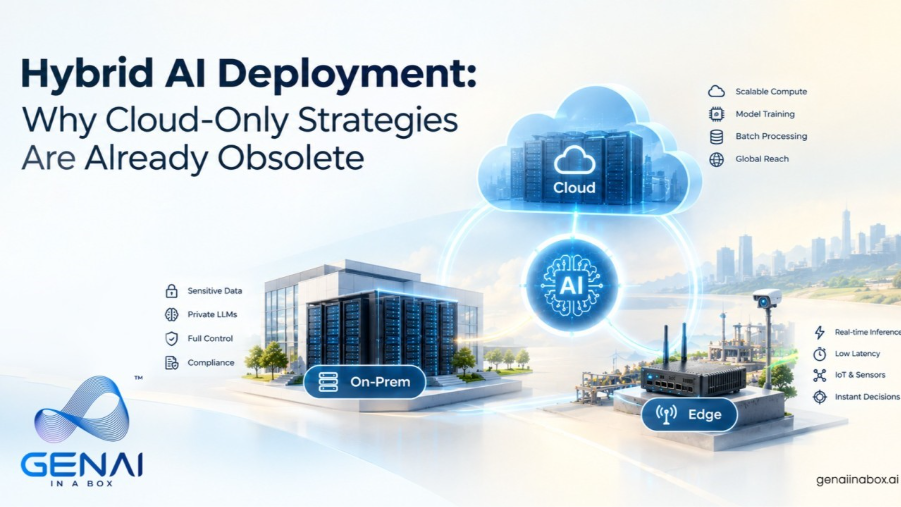
Forward-thinking enterprises now deploy AI across three layers:
Edge (Device/Local): Real-time inference where latency is unacceptable. Computer vision on manufacturing floors. Anomaly detection on network devices. Low-power, high-speed decisions made instantly.
On-Prem (Data Center): Sensitive data lives here. Private LLMs. Fine-tuned models on proprietary datasets. Full governance and control. Your data never leaves your infrastructure.
Cloud (Scalable Intelligence): Heavy lifting. Training pipelines. Batch processing. Cost-efficient compute for workloads that aren't time-critical. Third-party integrations that benefit from cloud elasticity.
The Result:
- 40% faster time-to-decision
- 60% reduction in compliance friction
- 3x better cost efficiency (you only pay for cloud when you need it)
- Zero vendor lock-in
Real-world deployment patterns:
Financial services firms run fraud detection on-prem (instant response required) while using cloud for quarterly model retraining at scale.
Healthcare systems keep patient data local, run diagnostic models at the edge in clinics, and leverage cloud for population-health analytics.
Manufacturing plants perform real-time defect detection at the factory floor while centralizing predictive maintenance in the cloud.
The Implementation Challenge
Hybrid deployment sounds logical. Executing it is hard.
You need:
✅ Unified model management across environments
✅ Consistent monitoring and observability
✅ Seamless data pipelines that respect compliance
✅ A platform that treats hybrid as first-class, not an afterthought
Most enterprises patch together Kubernetes, MLOps tools, and cloud SDKs. It works, barely. It's also fragile, expensive to maintain, and constantly breaks when you scale.
The Better path
Purpose-built hybrid AI platforms handle this complexity. They abstract away environment differences while giving you full visibility and control. Deploy once. Run anywhere. Scale without reinventing.
The Hybrid Future
Cloud-only was always a simplification. Enterprise AI requires nuance. Different workloads. Different requirements. Different threat models.
The companies winning today aren't debating where AI should run. They're strategically distributing intelligence where it creates the most value and building platforms that make this simple.
Hybrid isn't a compromise. It's the competitive advantage.