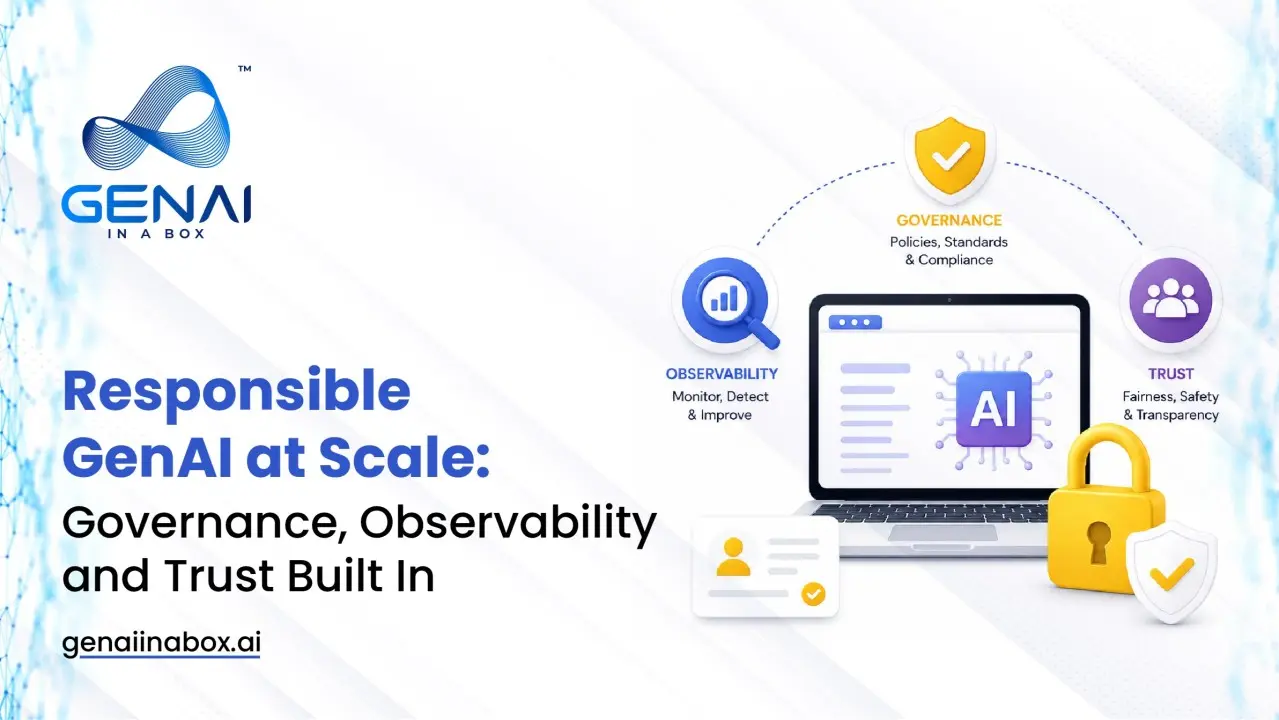
Deploying GenAI is the easy part. Deploying it responsibly at scale is where enterprises actually earn the return.
The pipeline is full. 80% of enterprises have 50+ generative AI use cases in the pipeline, but most have only a few in production. The bottleneck isn't ambition. It's accountability. 95% of GenAI pilots still fail because of missing governance and context. Not bad models. Not bad data. Missing governance. That's the real conversation in 2025.
Governance Isn't a Compliance Tax. It's the Foundation.
Most teams treat governance as something you bolt on before an audit. That's the wrong posture and an expensive one.
In 2025, AI governance is no longer a secondary consideration. It has become the foundation for responsible and profitable AI deployment in sectors such as finance, healthcare, and insurance.
The shift is structural: compliance needs to be integrated into AI operations, rather than treated as an afterthought reducing risk and speeding up AI deployment cycles.
Practically, this means governance lives inside the workflow not beside it. Every model decision, every output, every data input should carry a traceable lineage. AI model governance is the collection of policies, processes, and controls that ensure models are transparent, explainable, compliant, and trustworthy across their lifecycle providing guardrails to avoid bias, privacy risks, opaque lineage, and regulatory scrutiny. Build it in from day one, or spend twice as long retrofitting it later.
Observability: You Can't Govern What You Can't See
Here's a truth most teams learn the hard way: a deployed model is not a finished model.
Weak observability and immature guardrails are the most common pain points in production. Enterprises cannot scale agents without trust, and trust comes from visibility.
Observability in GenAI means knowing in real time what your model is doing, why it's doing it, and when it's drifting from expected behaviour. Real-time observability should be maintained using monitoring dashboards and structured user feedback collection, with continuous monitoring for model drift, emerging bias, and operational risks critical to ensuring sustained compliance.
This isn't optional infrastructure for regulated industries. It's the baseline for any enterprise that's serious about scaling AI responsibly.
Trust Is Engineered, Not Assumed
Trust in GenAI doesn't come from a vendor's promise. It comes from the architecture.
As early agents take on more responsibility, human oversight matters as much as infrastructure. Regulated enterprises are leading by adding approvals and review controls, embedding governance directly into workflows rather than treating it as an afterthought.
Three things build enterprise-grade trust in practice:
✦ Explainability: every significant model output should have a traceable reasoning path. If your AI can't show its work, your risk team can't approve it.
✦ Access control: who can query what model, on what data, under what conditions. Governance without access policy is just documentation.
✦ Audit readiness: a balanced, risk-based governance approach that enables both innovation and oversight, with adaptable risk assessment tools and continuous monitoring practices.
Scale Responsibly or Don't Scale at All
56% of enterprises say it takes 6–18 months to move a GenAI project from intake to production. Faster deployment starts with better governance not less of it.
The enterprises pulling ahead aren't the ones moving fastest. They're the ones moving with clarity on risk, visibility into performance, and governance wired into every layer of the stack. That's not caution. That's competitive advantage.
GenAI-in-a-Box.ai is built for enterprises that refuse to choose between speed and responsibility. Purpose-built infrastructure, governance-ready from deployment so your AI scales without your risk team losing sleep.
Build responsibly at genaiinabox.ai


