How GenAI Is Evolving Toward Autonomous Task Execution and Goal-Driven Intelligence
Generative AI proved that machines could understand language, generate content, and accelerate work at scale. But as enterprises move past experimentation, a sharper question emerges: Is generation enough?
Increasingly, the answer is no.
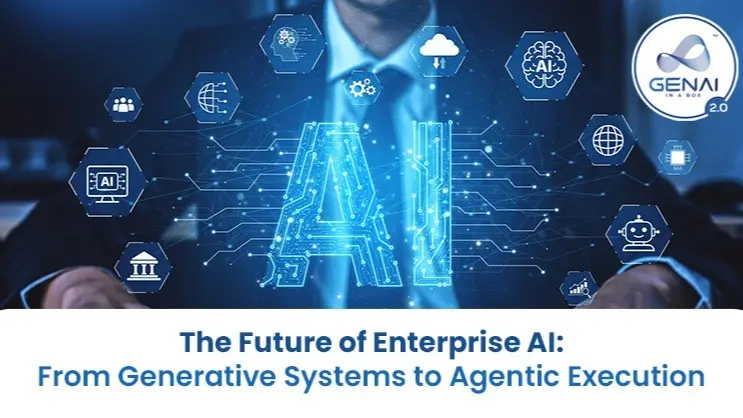
The next phase isn't about better responses. It's about systems that act agents that execute tasks, coordinate workflows, and deliver outcomes with minimal human oversight. This evolution from generative to agentic AI marks a fundamental shift in how enterprises deploy intelligence.
From Answering Prompts to Executing Workflows
Generative AI excels at producing outputs based on learned patterns. Agentic AI goes further it interprets objectives, selects tools, executes multi-step workflows, and adapts based on results.
This distinction matters in enterprise environments. Businesses need systems that don't just respond but act autonomously within defined boundaries. Analysts predict that by 2027, a significant share of enterprise AI workloads will involve autonomous task execution, particularly in operations, finance, and customer experience.
Reporting evolved into real-time analytics. Automation evolved into intelligent workflows. GenAI is now evolving into agentic systems that operate continuously, not just on demand.
What Makes AI Agentic?
At the core of agentic AI are systems capable of task decomposition, tool orchestration, and autonomous execution. Unlike traditional GenAI that responds to single prompts, agentic systems break goals into steps, determine which tools or APIs to invoke, validate outcomes, and iterate until objectives are met.
In BFSI, this means agents that monitor risk signals, assess exposure, and trigger pre-approved actions within regulatory bounds. In healthcare, agents assist clinicians by evaluating patient data against protocols and flagging critical deviations. In manufacturing, they adjust production schedules dynamically based on demand or supply changes.
This isn't automation replacing people its intelligence executing on human intent at scale.
Why Agentic AI Demands Higher Standards
When AI systems move from recommendation to execution, the stakes shift entirely. Agentic intelligence amplifies both value and risk.
These systems are only as reliable as the data and permissions they operate on. Fragmented data, unclear access controls, or weak governance don't just cause errors they cause compounding failures across workflows. Data quality, lineage, and context become mandatory, not optional.
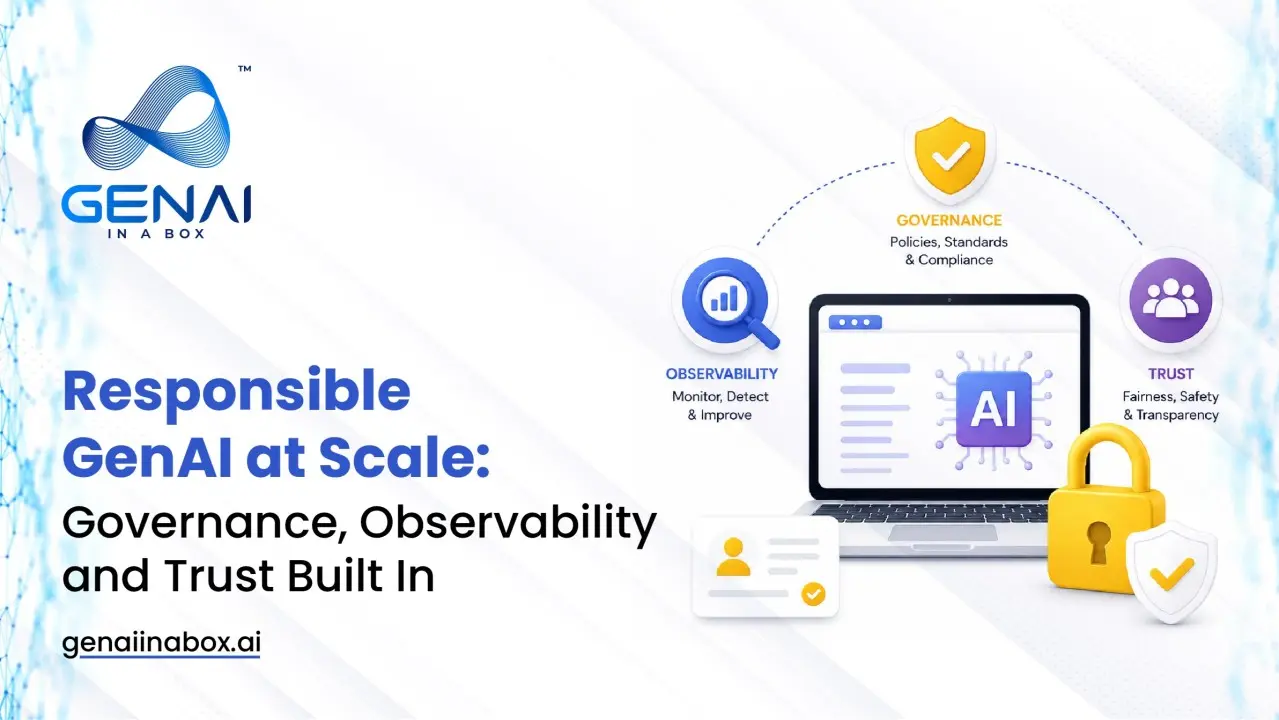
Governance becomes foundational. Enterprises must define which tasks agents can execute, where human approval is required, and how actions are logged and audited. Regulators increasingly emphasize explainability, accountability, and human oversight for autonomous AI systems. Without these guardrails, agentic AI cannot scale responsibly.
Trust is the limiting factor. Organizations succeed with AI not because the technology works, but because they trust it enough to deploy it broadly.
From Static Responses to Adaptive Task Execution
Agentic AI also shifts from static model inference to adaptive execution. Traditional GenAI models are retrained periodically. Agentic systems learn in production monitoring performance, detecting drift in task completion rates, and refining their approach over time.
This allows enterprises to move from one-time AI projects to persistent systems that evolve alongside business conditions. Research indicates organizations adopting agentic AI can significantly outperform peers in operational efficiency and responsiveness.
But adaptation without boundaries creates problems. Continuous learning must operate within enterprise policies, ethical boundaries, and compliance frameworks. Agentic AI demands discipline as much as innovation.
The Reality: Human-Agent Collaboration
Agentic AI isn't about replacing decision-makers. The near-term reality is collaborative agents handle execution speed, complexity, and pattern recognition. Humans define objectives, constraints, and escalation protocols.
Enterprises that succeed will treat agentic AI as a capable partner that extends human capability rather than competes with it.
Building the Foundation with GenAI-in-a-Box
Moving from generative to agentic AI isn't a single upgrade it's an architectural evolution.
Enterprises need secure data foundations, governed tool access, agent orchestration frameworks, and built-in compliance and auditability. Most importantly, they need an approach that allows experimentation today while preparing for autonomous execution tomorrow.
GenAI-in-a-Box is designed for exactly this journey.
It enables enterprises to operationalize GenAI with domain-tuned models, private deployments, governed data pipelines, and enterprise-grade controls creating a foundation where agentic systems can safely emerge. Instead of stitching together tools, teams start with a production-ready architecture built for scale, security, and continuous evolution.
The organizations that win won't be those chasing the newest models. They'll be the ones building trustworthy, adaptive agents that integrate deeply into how work gets done.
The future of enterprise AI isn't just about generating answers.
It's about executing tasks faster, safer, and continuously.
Ready to move beyond experimentation?
Explore how GenAI-in-a-Box helps enterprises evolve from generative capabilities to agentic systems without compromising governance, security, or control.
Visit: https://genaiinabox.ai/