Moving from Pilot Experiments to Production-Grade Impact
Generative AI has crossed the experimentation threshold. Healthcare is on track for nearly $46B in GenAI deployments, banking is positioned to unlock $200–340B in annual value, and manufacturing stands to eliminate hundreds of billions in operational costs. The opportunity is established.
What remains unresolved is execution
Across sectors, adoption is accelerating, but outcomes diverge sharply. Some organizations scale GenAI into core operations within weeks. Others remain stuck in proof-of-concept cycles. The difference is not model capability it is whether GenAI is treated as a tactical tool or as enterprise infrastructure.
Healthcare: Operational Relief with Clinical-Grade Governance
Healthcare’s most impactful GenAI deployments focus on administrative efficiency rather than experimental innovation. Clinical documentation continues to consume a disproportionate share of physician time, contributing directly to burnout and reduced patient throughput. Embedded GenAI documentation workflows are already reclaiming minutes per patient encounter gains that compound rapidly across departments.
However, scaling these improvements requires strict governance. One healthcare delivery network achieved early productivity gains but faced barriers around HIPAA compliance, auditability, and data residency. By deploying GenAI through a zero-copy architecture using GenAI-in-a-Box, patient data remained fully within the organization’s security boundary. Documentation was generated, summarized, and governed in place, reducing documentation effort by approximately 25–30% without compromising regulatory controls. The differentiator was not intelligence, but production-grade governance integrated into clinical workflows.
BFSI: Embedding GenAI Where Risk, Revenue, and Regulation Converge
In banking and financial services, GenAI adoption concentrates in high-impact domains such as fraud detection, customer service automation, and compliance workflows. Behavioural analysis across transactions, devices, and locations enables faster anomaly detection than traditional rules-based systems, while conversational AI platforms reduce service costs through large-scale query deflection.
Operationalizing GenAI through GenAI-in-a-Box allowed the institution to enforce semantic prompt filtering, role-based access controls, and audit-ready logging by default. As a result, fraud investigation cycles were reduced by nearly 40%, customer service deflection exceeded 50%, and AML reporting workflows accelerated without introducing additional regulatory risk. GenAI transitioned from experimental capability to regulated, auditable infrastructure.
Manufacturing: Accelerating Operations Without Compromising IP
Manufacturing applies GenAI where operational speed and precision deliver immediate returns design optimization, predictive maintenance, and automation support. Faster CAD iterations, early failure detection, and AI-assisted PLC code generation are already reducing downtime and development cycles.
However, manufacturers face distinct risks, particularly around intellectual property exposure and unsafe automation. One industrial enterprise mitigated these risks by deploying GenAI at the edge using GenAI-in-a-Box, ensuring proprietary designs and operational data never left the perimeter. The deployment enabled faster maintenance insights, safer automation workflows, and shop-floor adoption in weeks rather than months. GenAI delivered value because safety and control were foundational, not retrofitted.
Cross-Industry Insight: Why Some GenAI Deployments Scale
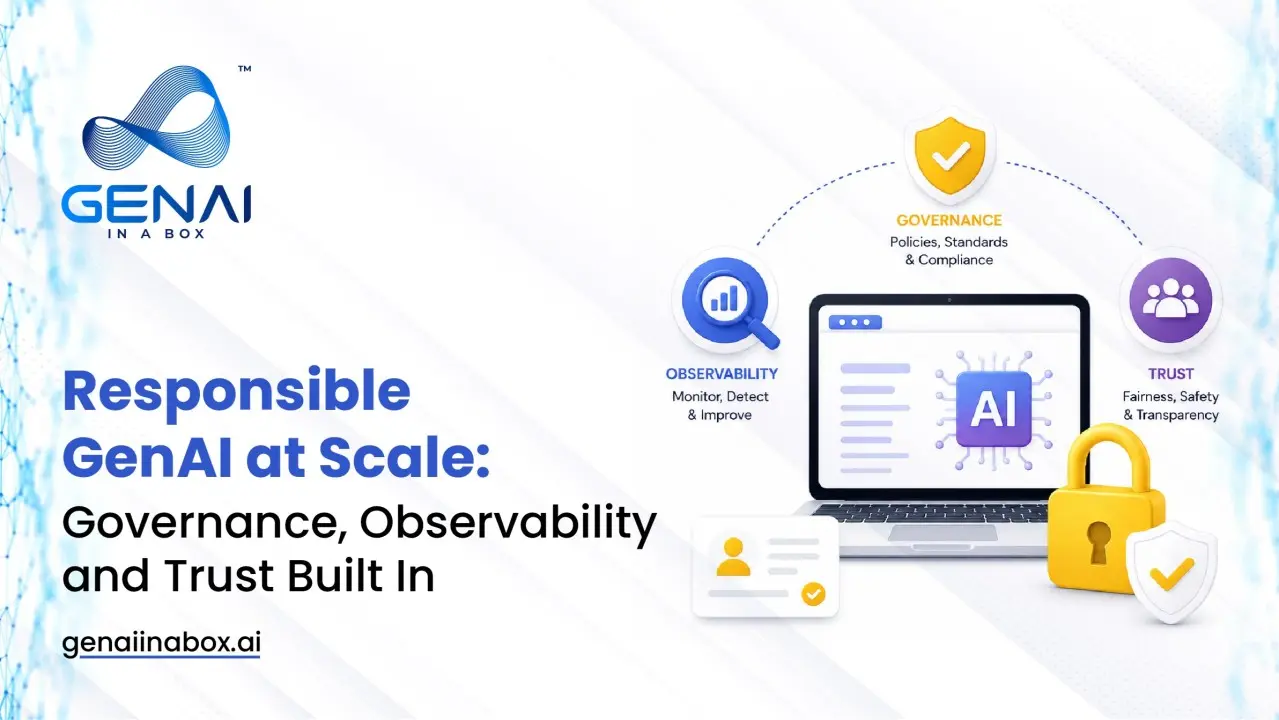
Across healthcare, BFSI, and manufacturing, successful GenAI programs share common characteristics. They prioritize domain-specific, high-value workflows over generic copilots. Governance is embedded into architecture rather than enforced through policy alone. ROI is measured continuously, and scale follows control not the other way around.
GenAI’s advantage over traditional AI is speed, but speed without guardrails introduces risk rather than value. Sustainable impact comes from aligning velocity with governance.
From Pilot Programs to Enterprise Infrastructure
The GenAI opportunity is real but realizing it requires structural readiness. Organizations that succeed do not chase novelty; they redesign workflows, security models, and governance frameworks to support AI at scale.
GenAI-in-a-Box is built to enable that transition. With industry-specific workflows, compliance-first deployment models, and enterprise-grade guardrails, it allows organizations to move from pilot to production without sacrificing trust or operational momentum.
GenAI does not fail due to lack of capability. It fails when organizations are not prepared to operate it at scale.
👉 Explore GenAI-in-a-Box: https://genaiinabox.ai/