Prompt Engineering Is Not Engineering. Until You Measure It.
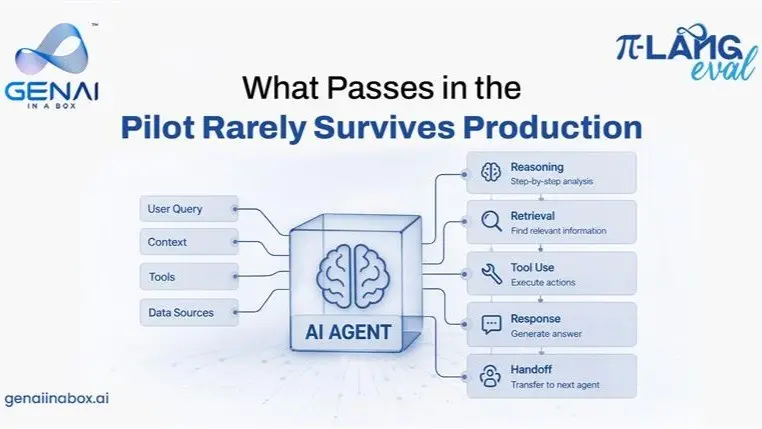
A clever instruction here, a few shot examples there, and suddenly the demo looks brilliant. The stakeholders nod. The pilot gets greenlit. And then somewhere between the demo room and the production server it quietly falls apart.
Here's the uncomfortable truth the industry is dancing around: prompt engineering without measurement is not a discipline. It's intuition with a job title.
The Gap Nobody Budgets For
McKinsey found that while nearly 78% of companies now use GenAI in at least one business function, just as many report realising no significant bottom-line impact. That paradox has a name, and it lives squarely in the space between "it worked in the demo" and "it works in production."
A synthesis of data from RAND Corporation, McKinsey, Deloitte, and Gartner across 2,400+ enterprise AI initiatives found that 80.3% of AI projects fail to deliver their intended business value and 33.8% are abandoned before ever reaching production.
The instinct is to blame the model. The data says otherwise.
The real culprit is the absence of systematic measurement of prompts, of outputs, of the entire evaluation pipeline. Most teams iterate based on vibes: a few good outputs, a thumbs up, and it ships. LLM outputs are non-deterministic by design. What works in a demo or MVP often fails in production. Human intuition does not scale you can manually test 10 to 100 prompts, after which prompt engineering without measurement is simply guesswork.
When "Engineering" Becomes the Right Word
Real prompt engineering the kind that belongs in a production system requires four things most teams skip:
1. Repeatability: The same input should produce consistently acceptable output across runs, users, and time zones. If it doesn't, you don't have a prompt. You have a lottery ticket.
2. Scoring: Answer relevance, faithfulness, conciseness, bias these aren't qualitative impressions. Structured prompt processes reduce AI errors by up to 76% and correlate with 34% higher satisfaction in AI implementations. That's measurable. That's engineering.
3. Regression testing: Changing a prompt should not be a leap of faith. Every tweak needs to be tested against a golden dataset before it touches a live system. Current evaluation frameworks privilege narrow technical metrics while neglecting safety, human-centered, and economic dimensions a gap that causes systems excelling on benchmarks to fail in real-world deployment. (Source: systematic review of 84 papers, 2023–2025)
4. Observability across the full stack: Gartner's 2025 Innovation Insight on LLM Observability identifies it as "the strategic enabler for deploying and scaling solutions responsibly and efficiently." Without it, you're operating blind.
The Platform That Closes the Gap
This is exactly the problem our Pi-LangEval is built to solve.
Pi-LangEval's "Write Once, Run Anywhere" evaluation config lets a single template run against live production traces or test datasets with a simple toggle your CI/CD tests become your production monitors instantly, eliminating the need to maintain separate testing and monitoring logic.
Beyond that, it brings:
▸ Hallucination & faithfulness scoring LLM-as-a-Judge built in
▸ RAG context precision know whether the problem is retrieval, context, or generation
▸ Auto-discovery of agent architectures no manual configuration
▸ BLEU, ROUGE, and qualitative scoring quantitative and qualitative, in one place
▸ Strict-schema dataset management golden samples, not loose CSV uploads
Gartner predicts that by 2027, at least 55% of software engineering teams will be actively building LLM-based features and the teams that win will be the ones who treated evaluation as infrastructure, not an afterthought. Gartner
The Bottom Line
Prompt engineering earns the "engineering" label the moment it becomes measurable, repeatable, and auditable. Until then, it's creative writing under pressure.
Pi-LangEval is listed as a solution on AWS Marketplace available to enterprises ready to move from intuition to evidence